Is Glass Recyclable? The Definitive Guide (What to Toss & What to Keep)
Everything you’ve ever wanted to know about glass recycling—including the types most people get wrong.
Let me guess: you’re holding a cracked Pyrex dish, a broken wine glass, or an old mirror, and you’re wondering — does this go in the recycling bin or not?
You’re not alone. Glass recycling is one of the most misunderstood topics in household waste management. The confusion is understandable because glass looks like glass. But from a recycling chemistry standpoint, a wine bottle and a baking dish might as well be from different planets.
In this guide, I’ll break it all down — what’s recyclable, what isn’t, why the science matters, and what to do with the tricky stuff. Let’s get into it.
The Quick-Check List: What Can (and Can’t) Be Recycled
Before we dive into the why, here’s a plain-English checklist. Save this to your phone — you’ll use it more than you think.
- Wine & beer bottles
- Jam & pickle jars
- Sauce and condiment bottles
- Spirit & liqueur bottles
- Juice and milk glass bottles
- Cosmetic glass jars (rinsed)
- Pyrex & ovenproof cookware
- Drinking glasses & mugs
- Mirrors
- Window panes & car glass
- Light bulbs
- Lead crystal glassware
- Ceramic items (not glass, but often confused)
The golden rule: if it held food or drink and it’s a bottle or jar, it almost certainly belongs in the recycling bin. Everything else? Read on.
Why Isn’t All Glass Recyclable? (The Science Behind It)
Here’s where it gets genuinely fascinating — and where most guides let you down by skipping the explanation.
The melting point problem
Standard container glass (bottles and jars) melts at around 1,500°C (2,732°F). Recycling plants are calibrated precisely for this temperature. When you throw in a piece of Pyrex, the problem isn’t that it won’t melt — it’s that it won’t melt at the same rate.
🔬 The “Stone” Effect
Pyrex and heat-resistant cookware are made with borosilicate glass, which has a significantly higher melting point. When it enters a glass furnace at the standard temperature, it doesn’t fully liquify — it creates solid lumps called “stones” in the finished product. These stones weaken new glass bottles and cause them to crack or shatter unexpectedly. One contaminated batch can ruin thousands of new bottles.
Chemical additives
Lead crystal glassware is another recycling villain. Those beautiful old decanters and wine glasses are typically made with lead oxide added to the glass mixture, giving them that distinctive shine and weight. Lead contaminates the recycling stream and creates hazardous material that recycling facilities simply aren’t equipped to handle safely.
Window glass and car windscreens contain additional coatings, laminates, and tints that similarly disrupt the recycling process. The glass itself isn’t the issue — it’s everything that’s been added to it.
“Contamination is the single biggest challenge in glass recycling. One wrong piece can trigger an entire batch rejection. Education at the household level is where the real gains are made.” — Dr. Sarah Chen, Environmental Engineering, University of Bristol
How to Prepare Your Glass for Recycling (Step-by-Step)
Good news: preparing glass for recycling is much simpler than most people think. You don’t need to spend 10 minutes scrubbing an old pasta sauce jar. Here’s the real process:
Rinse it out (loosely)
Give the jar or bottle a quick rinse to remove the majority of food residue. You don’t need to get it spotless — the furnace will take care of the rest. Just make sure it’s mostly empty. A thin film of sauce? Totally fine. Half a jar of pickles? Not fine.
Lids and caps — leave them on or take them off?
This one surprises people. For metal lids (like those on jam jars), the current industry trend is to leave them on. Metal can be separated during the sorting process, and a loose lid often gets lost in the recycling machinery. For plastic caps on glass bottles, check your local guidance — policies vary by region.
Do you need to remove labels?
Nope. Paper and plastic labels burn off entirely in the furnace. Peeling them is a nice gesture but completely unnecessary. Save yourself the time.
Coloured glass: separate or together?
This depends on your local collection system. Some areas want glass sorted by colour (clear, green, brown) because mixing colours affects the finished product’s clarity. Others use advanced sorting technology that handles mixed glass. When in doubt, check your local council or waste management provider’s website.
Broken Glass: The Safety vs. Recycling Dilemma
One of the most-searched questions in this space: Can you recycle broken glass?
The honest answer is: it depends on how it broke and where you are.
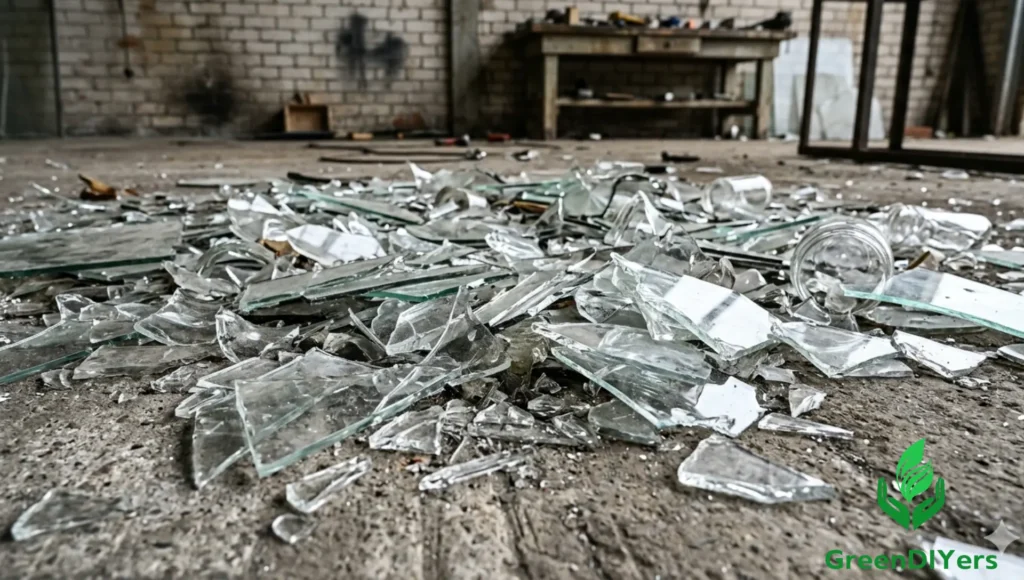
In most curbside collection programs, broken glass is rejected — not because it can’t technically be recycled, but because it poses a serious safety risk to collection workers and sorting plant staff. Sharp fragments easily puncture bags and injure hands.
How to dispose of broken glass safely
If you can’t recycle it curbside, here’s the safest disposal method:
Wrap it in newspaper or cardboard
Fold several sheets around the fragments and secure with tape. This prevents punctures and protects bin workers.
Label the package clearly
Write “BROKEN GLASS” visibly on the outside. Waste workers appreciate the warning.
Place in general waste (not recycling)
Unfortunately, most broken glass ends up in landfill. Some specialist glass recyclers accept it — search for glass recycling drop-off points in your area for a better option.
The Environmental Win: Why Glass Recycling Actually Matters
Let’s talk about why this all matters beyond just “doing the right thing.”
The infinite factor
Unlike plastic, which degrades in quality every time it’s recycled (eventually becoming unusable), glass can be melted down and reformed endlessly without any loss in purity or strength. A wine bottle you recycled 10 years ago could literally be the same wine bottle sitting on your shelf today.
The energy savings from “cullet”
Recycled glass, known in the industry as cullet, melts at a lower temperature than virgin raw materials. This means glass furnaces consume significantly less energy when processing recycled content — up to 30% less per tonne in some estimates. At an industrial scale, that’s a meaningful reduction in both energy costs and carbon emissions.
Compare this to plastic: every plastic “recycling” cycle produces a lower-grade material. Glass recycling is genuinely circular in a way that most materials simply aren’t. Curious how other everyday packaging stacks up? Check out our guide on whether bubble wrap is recyclable — the answer might surprise you.
Creative Upcycling: What to Do with Non-Recyclable Glass
So you’ve got an old mirror, a chipped drinking glass, or a set of Pyrex that’s seen better days. It can’t go in the recycling bin — but that doesn’t mean it has to go straight to landfill.
Here are some genuinely useful alternatives:
- Donate to charity shops or Freecycle (if unbroken)
- Use jam jars as drinking glasses or storage pots
- Turn wine bottles into garden edging or vases
- Use broken mirror pieces for mosaic art projects
- Convert glass bottles into candle holders or lamps
- Use old Pyrex dishes as garden cloches for seedlings
- Bring to household waste recycling centres (many accept specialist glass)
- Contact specialist glass recyclers who handle non-container glass
A little creativity goes a long way. And if you’re into DIY, glass jar projects in particular are endlessly versatile — from bathroom storage to fairy light displays to herb planters on a kitchen windowsill.
Frequently Asked Questions
Yes — coloured glass (blue, green, amber, brown) is fully recyclable. The colour comes from metal oxides added during manufacturing and doesn’t affect recyclability. However, some facilities prefer you separate by colour to preserve the quality of the recycled product. Clear glass commands the highest value, so mixing green glass into a clear batch reduces its worth. Check whether your local scheme requires colour separation.
Generally, it’s fine. Small metal lids and rings are separated from glass during the recycling process using magnets and air jets. Leaving a metal lid on is now actively encouraged by many recycling programmes because loose lids can clog sorting machinery. The main exception is aluminium foil seals — remove these where possible as they can contaminate the glass stream in some facilities.
It depends on the metric. Glass is heavier than plastic, which means more energy is used in transportation — that’s a genuine downside. However, glass is infinitely recyclable without quality degradation, while most plastics can only be “downcycled” a few times. Glass also doesn’t leach chemicals, doesn’t microplastic, and has a much longer functional lifespan. For products designed to be refilled and reused (milk bottles, growlers, etc.), glass is clearly the better environmental choice. For single-use packaging with long supply chains, the comparison is more nuanced.
No. A quick rinse to remove bulk food residue is sufficient. Labels, thin films of food, and minor residue are all dealt with during the industrial processing stage. The furnace reaches temperatures that incinerate organic material completely. Obsessively washing your jars before recycling wastes water and time — a light rinse is all you need.
Glass recycling infrastructure exists in most developed countries, but the systems vary significantly. Germany, the Netherlands, and Switzerland have among the world’s highest glass recycling rates (above 80%), driven by well-funded deposit return schemes and dense collection networks. The US average is around 31–33%, while the UK sits around 75% for household glass. In many developing nations, glass is often recycled informally through deposit systems or small-scale collectors rather than municipal programmes. Always look up your local authority’s specific guidance.
The Bottom Line
Glass recycling isn’t complicated once you understand the basics. The vast majority of what comes out of your kitchen — wine bottles, jam jars, sauce bottles, beer bottles — is absolutely recyclable and genuinely worth putting in the bin.
The items that trip people up (Pyrex, mirrors, drinking glasses) have real scientific reasons they can’t be recycled conventionally. Knowing that makes it easier to remember, and harder to accidentally contaminate a perfectly good batch.
A few seconds of thought before you toss that jar? It’s one of the easiest environmental wins available to you. And unlike most sustainability advice, this one doesn’t cost you anything.