Bee Crafts for Kids [35+ Easy Ideas for 2026]
By Bilal Al-Khaldi
Did you know bees pollinate about one-third of the food we eat? These tiny, buzzing heroes deserve a little appreciation — and what better way to celebrate them than through creativity? Whether you’re a parent looking for a rainy-day activity, a homeschooler planning a nature unit, or a preschool teacher searching for fun projects, these bee crafts are exactly what you need. The best part? Most use common household items you already have.
Let’s dive into a hive full of creative fun.
Table of Contents
- Bee Crafts for Toddlers (Ages 2–4)
- Recycled Bee Crafts (Eco-Friendly Ideas)
- Educational STEM Bee Activities
- Free Bee Craft Templates
- Step-by-Step Featured Craft: The Recycled Paper Roll Bee
- FAQ
Section 1: Bee Crafts for Toddlers (Ages 2–4) {section-1}
Toddlers are natural explorers — they love touching, squishing, and making a glorious mess. These bee crafts for kids in the 2–4 age range are designed with that beautiful chaos in mind.
1. Footprint Bees
This one’s a classic for a reason. Press your toddler’s foot in yellow paint, stamp it on paper, and let it dry. Then add black stripes, googly eyes, and little paper wings. The oval footprint shape makes a perfect bee body!
🍎 Teacher’s Tip: Footprint crafts build body awareness and introduce concepts like symmetry. Hold the stamped foot up and say, “That’s the shape of your foot!” It sparks self-recognition — a key milestone for toddlers.
2. Paper Plate Bees
Grab a paper plate, some yellow and black paint, and you’re halfway there. Little ones paint yellow and black stripes alternately, glue on wax paper wings, and add a pipe cleaner antenna. Simple, satisfying, and proudly displayable on any fridge.
🍎 Teacher’s Tip: Painting stripes encourages fine motor control — guiding a brush in a line is a subtle but important precursor to writing skills.
3. Fingerprint Hive
Dip little fingers in yellow and orange paint to create a honeycomb pattern on black construction paper. Each fingerprint becomes one cell in the hive. Add tiny bee stickers or drawn bees flying around the comb.
🍎 Teacher’s Tip: Repeating the fingerprint motion in a pattern introduces early mathematical thinking — pattern recognition is one of the first forms of mathematical reasoning.
Section 2: Recycled Bee Crafts (Eco-Friendly Ideas) {section-2}
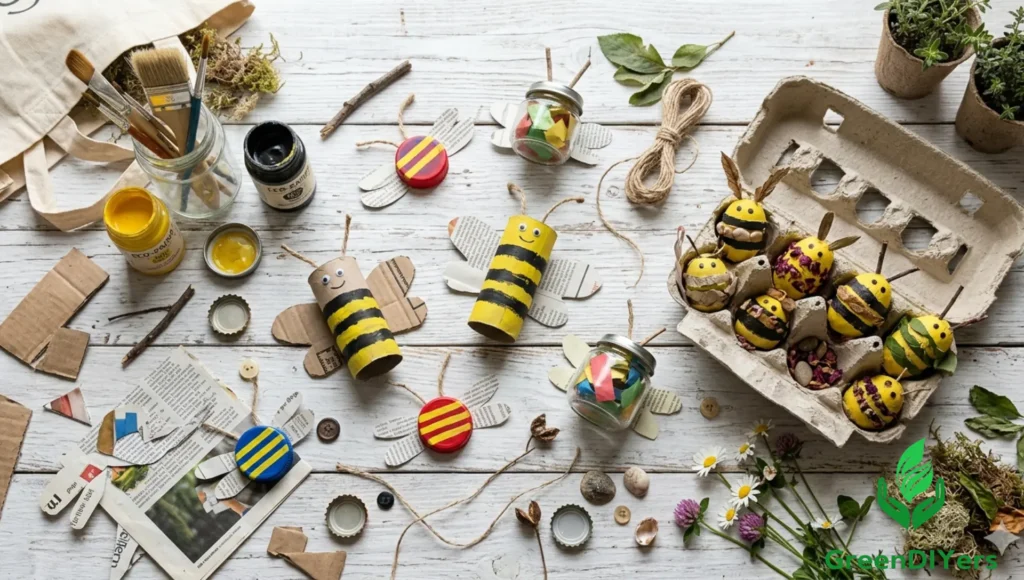
These bee craft ideas use materials destined for the recycling bin — so you’re saving the planet and making something adorable. It’s a win-win that kids actually get excited about.
4. Toilet Paper Roll Bees
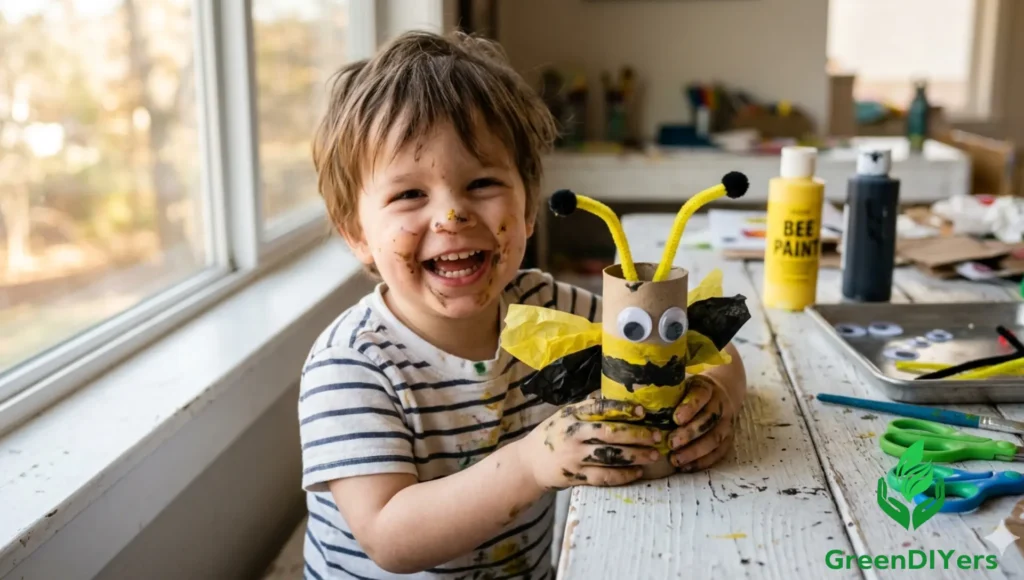
Ah, the classic toilet paper roll. Paint it yellow and black, add googly eyes, cut out wings from white tissue paper or a used plastic bag, and you’ve got a bee that stands on its own. These look fantastic on a classroom windowsill.
What you need:
- Empty toilet paper rolls
- Yellow and black paint
- Googly eyes
- Tissue paper or thin plastic for wings
- Pipe cleaners for antennae
5. Tin Can Planters (Bee-Themed)
Wash out an empty tin can, paint it in yellow and black stripes, and use it as a little planter. Pop in some wildflowers or herbs to complete the eco-friendly bee craft. Bonus: you can tie this into a lesson about why bees need flowers and what pollinators do.
Eco-friendly tip: Use leftover paint from other projects to reduce waste.
6. Egg Carton Bumble Bees
Cut individual cups from an egg carton, paint them yellow and black, and add wings and antennae. These egg carton bumble bees have a delightful 3D texture that kids love touching and examining.
Section 3: Action-Oriented & Engaging (Focuses on the doing) {section-3}
Here’s where bee crafts get seriously clever. These activities blur the line between making and learning — and honestly, that’s the sweet spot.
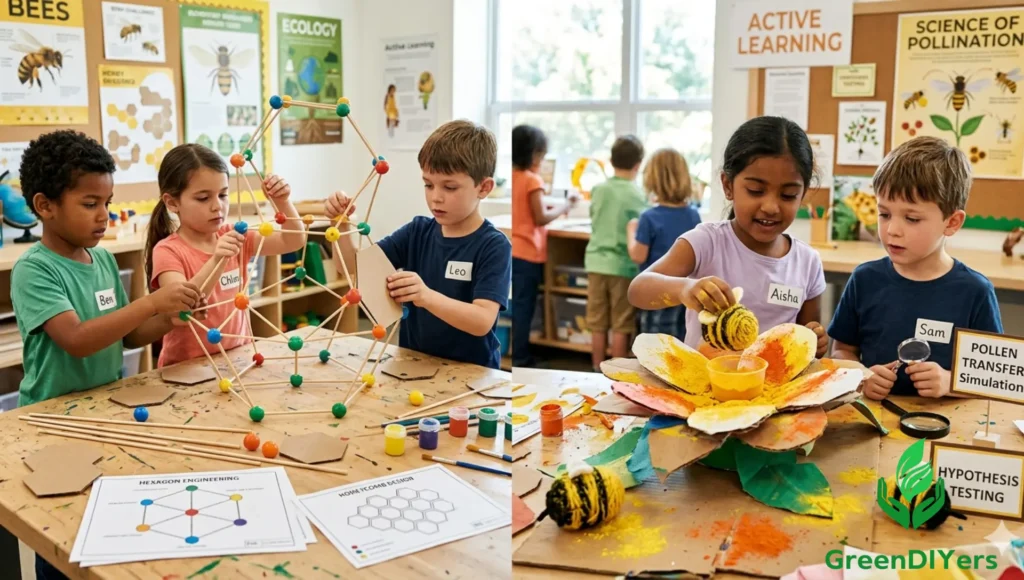
7. Hexagon Honeycomb Building (Math)
Honeycombs are one of nature’s most efficient shapes. Challenge kids to build their own using:
- Cardboard hexagons (cut or printed)
- Yellow and orange paint
- Tape or glue
As they piece the hexagons together, guide them through a conversation: Why do bees use hexagons? What other shapes could work? Which one uses the least wax? You’d be amazed how naturally the geometry conversation flows.
Skills covered: Geometry, spatial reasoning, engineering thinking
8. Pollen Transfer Simulation (Science)
This activity is a crowd-pleaser and genuinely illuminating. You’ll need:
- Several small bowls painted to look like flowers (or use real flowers)
- A cotton ball or pompom as the “bee”
- Different colors of powder (cornstarch mixed with food coloring works great)
- A plain white sheet for the “field”
Kids dip their “bee” into one flower, then move it to another, watching the pollen (color) transfer. After a few flowers, the bee is a multicolored mess — and that’s exactly the point.
Skills covered: Scientific observation, hypothesis testing, ecology
Section 4: Free Bee Craft Templates {section-4}
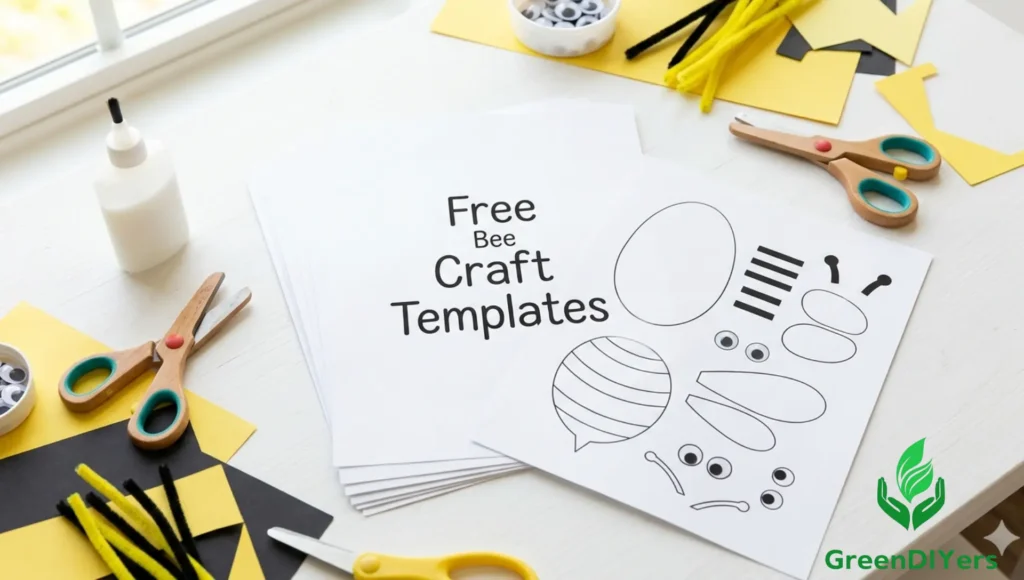
One of the most requested resources in craft communities is a solid printable template — and for good reason. Printable templates save prep time, ensure consistent results, and let kids focus on the creative part rather than the measuring-and-cutting part.
What’s Included in the Free Pack:
- Bee body outline (3 sizes: toddler, school-age, large group version)
- Hexagon honeycomb grid (for the STEM activity above)
- Wing shapes (round, pointed, and fantasy options)
- Bee face features (eyes, stingers, stripes guides)
- “My Bee” journaling page for older kids to document their creation
To get the free printables, bookmark this page and check the download section — they’re formatted to print cleanly on standard letter-sized paper with no extra software needed.
These templates also make this page a handy resource to share with fellow teachers and parents. If you find them useful, pass the link along!
Section 5: Step-by-Step Featured Craft — The Recycled Paper Roll Bee {section-5}
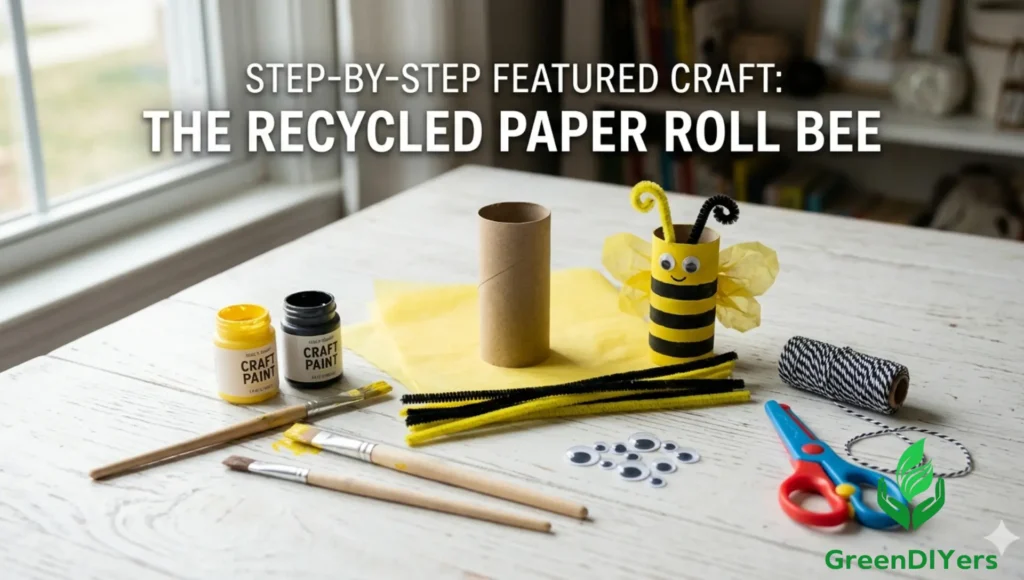
This is the craft that checks every box: it’s adorable, it’s eco-friendly, it uses household materials, and kids of all ages can participate (with a little age-appropriate tweaking). Let’s make it!
Difficulty: Easy
Time: 20–30 minutes
Age range: 3 and up (with adult help for cutting)
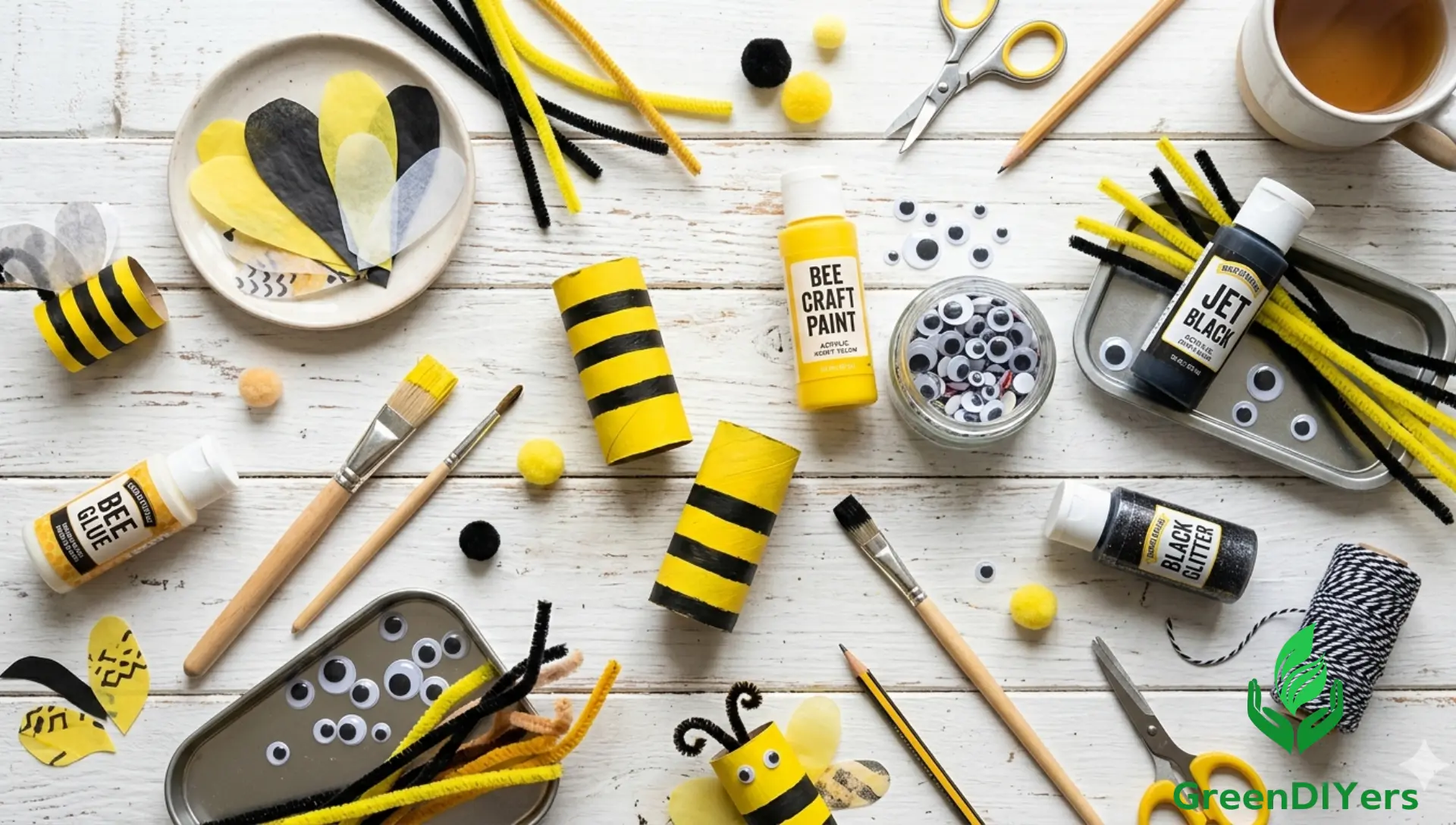
What You’ll Need
- 1 empty toilet paper roll
- Yellow and black acrylic or tempera paint
- 2 googly eyes
- White tissue paper or white foam sheet for wings
- 2 black pipe cleaners
- Scissors
- Craft glue or hot glue (adults only)
- Black marker
Step 1: Paint Your Bee’s Base
Cover the entire toilet paper roll in yellow paint. Give it two coats if needed for even coverage. Set it aside to dry completely — this is a great snack break opportunity!
Tip: Stand the roll upright in a small cup while it dries so it doesn’t roll off the table.
Step 2: Add the Stripes
Once the yellow is dry, paint 3–4 horizontal black stripes around the roll. Keep them roughly equal in width and spacing. Don’t stress about perfection — real bees have slightly irregular stripes too!
For younger kids: Use black tape strips instead of painting for easier cleanup.
Step 3: Cut the Wings
From your white tissue paper or foam sheet, cut two oval shapes approximately 3 inches long. For a more realistic look, draw light vein lines on the wings with a black marker before attaching them.
Step 4: Attach Wings and Eyes
Using craft glue (or hot glue for adults), attach the wings side by side on the upper back of the roll. Then glue the googly eyes toward the top front of the roll.
Let everything dry for at least 10 minutes before handling.
Step 5: Add the Antennae
Poke two holes in the top of the roll using a pencil. Thread one pipe cleaner through both holes and bend each end into a small loop (the antenna tips). Adjust so both antennae curve gracefully upward.
Step 6: Optional Finishing Touches
- Draw a little curved smile with black marker
- Add a tiny stinger shape at the bottom (cut from foam or cardboard)
- Write your child’s name on the inside of the roll — your bee is now personalized!
Display idea: Line up a whole swarm of these on a classroom shelf or string them with fishing line for a hanging bee mobile.
FAQ
What materials do I need for bee crafts?
Most bee crafts use everyday household items. The most common supplies include yellow and black paint, paper plates or toilet paper rolls, googly eyes, pipe cleaners, tissue paper or wax paper for wings, and scissors. You don’t need to buy anything special — that’s what makes these bee craft ideas so accessible.
How do you make a simple bee for preschool?
The easiest option for preschoolers is the paper plate bee. Paint a paper plate yellow, add black stripes once it’s dry, glue on googly eyes, and attach tissue paper wings. It takes about 20 minutes and requires minimal cutting. Footprint bees are also a fantastic no-fuss choice — all you need is yellow paint and a willing foot!
How do you make a bee out of a toilet paper roll?
Follow the step-by-step guide above! In short: paint the roll yellow, add black stripes, attach white wings cut from tissue paper, glue on googly eyes, and poke pipe cleaners through the top for antennae. It’s one of the most satisfying recycled bee crafts out there — and the finished result looks great displayed on a shelf or windowsill.
Final Buzz
Whether you’re making footprint bees with a giggling two-year-old or building hexagon honeycombs with a curious eight-year-old, these bee crafts offer something genuinely valuable: a chance to slow down, create something with your hands, and learn a little about the remarkable insects that keep our world blooming.
Got a favorite from this list? I’d love to hear which one you tried first. Drop a comment below or share a photo — there’s nothing better than seeing these little crafts come to life!
Happy crafting
Bilal Al-Khaldi